Living in Pattaya on a DTV: Rent for 180 Days or Buy?
The DTV after the 31 August 2026 changes, and how to live in Pattaya on it: a 180-day lease, your Thai address, tax days and when buying beats renting.
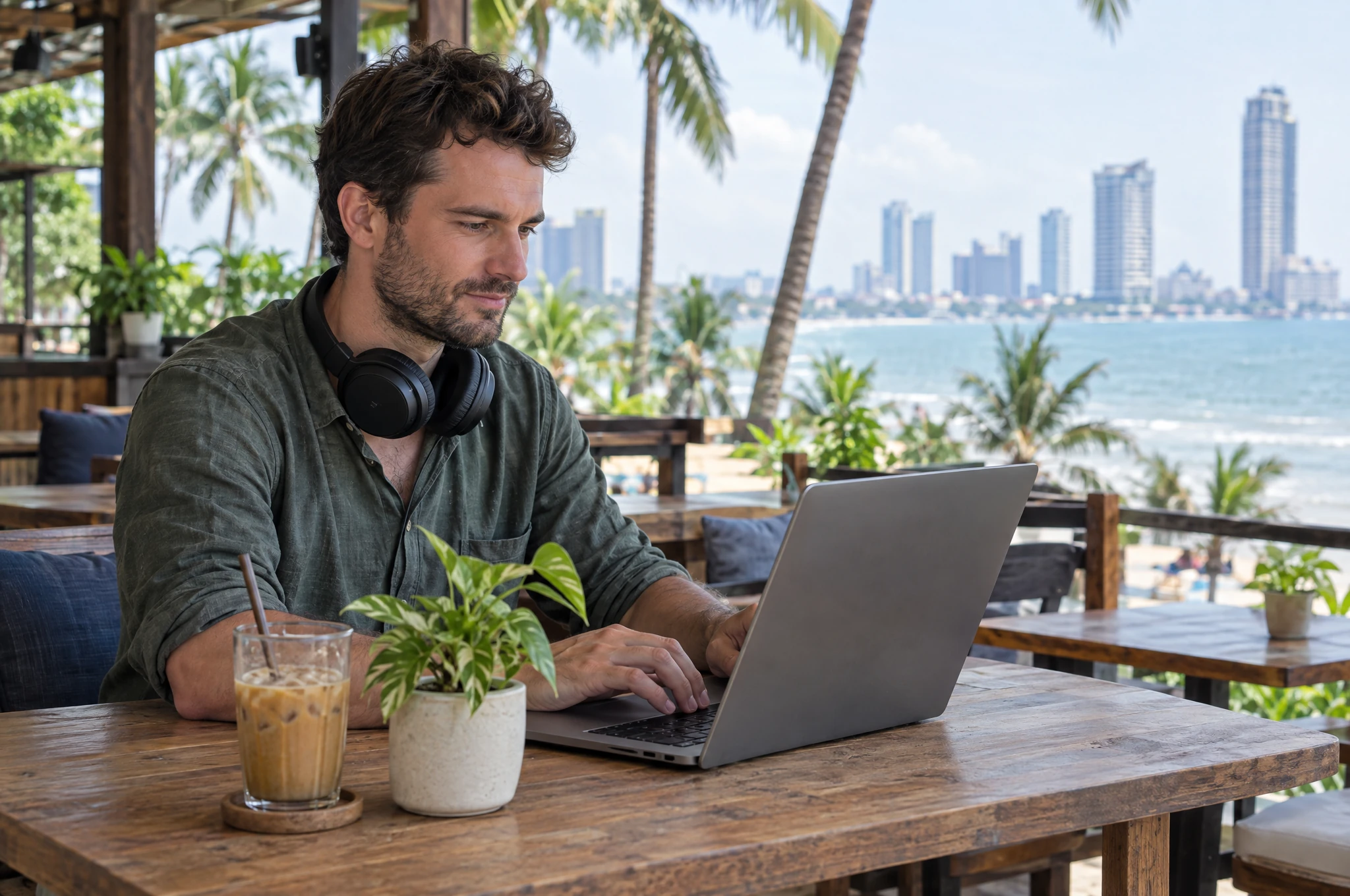
Short answer: the Destination Thailand Visa (DTV) lets remote workers, freelancers and their families live in Thailand for 180 days at a time, with one extension of up to 180 days, for five years. The visa does not ask for a Thai lease or property. Once you live in Pattaya on it, though, you need a Thai address: for TM30, the 90-day report and a bank. Most DTV holders rent first and buy only when they know they will spend half the year here for several years.
Below are the DTV rules after the changes of 31 August 2026, what renting for 180 days looks like in Pattaya, how those days affect your taxes, and when buying makes more sense than renting.
1. The DTV in brief
| Destination Thailand Visa | |
|---|---|
| Validity | 5 years, multiple entries |
| Stay per entry | 180 days |
| Extension | Once per entry, up to 180 days, at an immigration office in Thailand |
| Money | At least ฿500 000, shown on bank statements |
| Who qualifies | Remote workers, digital nomads and freelancers working for employers or clients outside Thailand; people on Thai “soft power” activities such as Muay Thai, Thai cooking or medical treatment; the spouse and children under 20 of a DTV holder |
| Embassy fee | Set by each embassy, for example £300 in London |
| Work for Thai employers or clients | Not allowed: the DTV is not a work permit |
2. What changed on 31 August 2026
Two documents changed for applications submitted from 31 August 2026:
- Proof of permanent residence in the country where you apply replaces the old document showing where you are now. In practice you apply from your home country or the country you live in, not on a short trip to a neighbouring one.
- A police clearance certificate issued within the last six months is now required.
Everything else stayed the same, and applications submitted before 31 August are processed under the old rules. Each embassy publishes its own checklist, so read the one for the embassy you apply through.
3. Does the DTV need a lease in Thailand?
No. The embassy checklists ask for your passport, a recent photo, proof of permanent residence abroad, ฿500 000 in funds, a police clearance and proof of your work or activity. A Thai lease is not on the list, whatever some agencies write.
A lease matters once you arrive:
- TM30. Your landlord reports you to immigration within 24 hours of moving in. Without the receipt you may not be able to file a 90-day report or extend your stay: see TM30 and 90-day reports in Pattaya.
- The 90-day report. A 180-day stay includes one: on day 90 you confirm your address with immigration.
- The 180-day extension is filed at the immigration office for the area where you live, with your Thai address.
- A bank account. Banks decide case by case whether to open an account for a DTV holder; a lease and a TM30 receipt help.

4. Renting in Pattaya for 180 days
A six-month lease matches one DTV stay. Long-term condo rentals in Pattaya are usually signed for six or twelve months, with a security deposit, often two months’ rent, plus the first month in advance.
- Internet. Ask for fibre in the unit itself, not only Wi-Fi in the lobby, and test the speed at the viewing or on a video call.
- Space to work. A one-bedroom with a separate living room is easier to work from than a studio, especially for calls.
- Electricity. Agree in the lease how it is charged: at the provider’s meter rate or at the owner’s own rate per unit.
- TM30. Write into the lease who files it and that you get the receipt.
- Area. Jomtien and Pratumnak are quieter, Wongamat and Naklua have newer beachfront towers, Central Pattaya is the busiest. Compare them on the map.
Condos for long-term rent are in our listings, or get a shortlist for your dates and budget.
5. 180 days and tax
Tax residence in Thailand depends on days, not on your visa. If you spend 180 days or more in Thailand in a calendar year, you are a Thai tax resident for that year. Since 2024, foreign income that a tax resident brings into Thailand is taxable there, and the DTV gives no special treatment. A 180-day stay that starts in early July can make you resident; one that runs from October to March is split between two years. Talk to a tax adviser before you plan your dates.
Rent from a condo you own in Thailand is taxable in Thailand in any case: see how rental income from a condo is taxed.
6. When buying beats renting
Buying makes sense when:
- you will spend at least half the year in Pattaya for several years: the DTV runs for five;
- you want a home that stays ready between stays: you lock it up or rent it out while you are away, and the tenant’s TM30 and the rental income tax are then yours;
- you have chosen the area after living in it, ideally after one rented stay.
What to know before you buy on a DTV:
- A foreigner can own a condo in their own name under the foreign quota, on any visa. Buying does not give you a visa, and the condo does not count towards the ฿500 000: does buying property in Thailand get you a visa.
- The money for the purchase must come from abroad in foreign currency: how foreigners pay for property. Keep the visa funds separate: if your savings go into the condo, your statements may no longer show ฿500 000 the next time you or your family apply.
- Owning has running costs, among them the common area fee and the sinking fund: extra costs of buying a condo; current prices: how much a condo costs in Pattaya in 2026.
Renting is the better choice for a first year, a short horizon or while you are still choosing the area.
7. Families on a DTV
A spouse and children under 20 apply as dependants with the main holder’s visa and proof of the relationship, such as a marriage or birth certificate. Documents issued outside Thailand need a certified English translation, certified in turn by an embassy or a ministry of foreign affairs. Each dependant pays the embassy fee.
For a family, a two- or three-bedroom condo or a house on a twelve-month lease is the usual start. Check the school run before you sign.
Related: TM30 and 90-day reports in Pattaya · visa-free stays from 15 September 2026.
Rules checked on 28 October 2026 against the DTV pages of the Thai embassies in London and Moscow. Each embassy publishes its own checklist and fee, so check yours before you apply.